Why there is no European Amazon, Google, Uber & Airbnb

When I started my online sales business with the enaA.com website in 1999, there was practically no legislation regulating this field. A grey area. Should I have waited for laws to be adopted in order to know how to work legally?
Seventeen years later and we are still far from having relevant laws in Slovenia which would support the development of online trading. All this in the country which has in the meantime succeeded in legalising same-sex marriages, the 21st country in the world to do so. I am proud of it. Really proud! I have also lived to see cannabis no longer being classified in the illicit drug class that attracts the most severe penalty and is now allowed to be grown and used for medicinal purposes. Slovenia is not exactly among the leading countries here but at least things have moved forward. We put the right to clean drinking water into the constitution.
And although European politicians refer to the development of the digital market as one of the most important generators of European economic growth, we online traders have so far received from them only legislation on web cookies, which has neither increased the volume of online sales in Europe nor improved user experience. Thus one cannot count on European companies to develop and compete with the American Amazon or the Chinese Alibaba. Sales of both companies to customers in EU countries have been growing steeply from year to year. Why? Because the countries of their origin have highly effective solutions regarding copyrights, customer protection, payment transactions and delivery, which allow for exceptionally low cost of selling throughout the world. Let us not forget that we are dealing here with a global retail sale with an average purchase price of about 20 euros in which every cent counts! Billions of contracts with the average value of peanuts. In Slovenia, the profit would already have evaporated during the administrative procedures related to re-export, VAT accounting, arrangement of copyrights and the costs associated with packaging waste and the destruction of electricity devices.
There may actually be only a handful of Slovenian photographers who sell their work on istock.com, yet every day there are more and more businessmen who know how to buy products in China and send them directly to Amazon warehouses in the USA to be re-sold from there. If we add to these Alibaba, eBay, Etsy and other similar online wholesale markets, this is not such a small business any more. But these marketplaces are not located in Europe and so the money goes other way.
Do we have legislation to regulate this? No. Are people who are doing this breaking laws? Not intentionally, for sure. Uber and AirBnB also want to operate their businesses legally. The fact that they are coming on to the market with a new business model should not be an obstacle. Both offer a very transparent operation, much more than, for example, issuing invoices in regular taxis or in renting rooms and suites via tourist associations on the Adriatic coast. Everything is electronic, everything is recorded. It is quite clear what the VAT value is, how much the operator gets and how much goes to the platform administrator. And then the state comes along to say that the business model is not entirely compatible with existing laws and regulations. Understandable. Of course. This is a new thing. We know. Don’t try to make me feel bad for driving with Uber. The sharing economy is an inevitable part of our present and the future. Write a new law. This is your business. The world is evolving! New business models are a constant. Write the best possible law so it will be talked and written about all over the world. Then the EU will become the e-centre of the world.
First published in Finance Manager (version for Slovene readers) http://manager.finance.si/8852131/Aljo%C5%A1a-Domijan-Zakaj-v-Evropi-ne-moremo-narediti-Alibabe-in-Amazona
What matters most in selling online?
At Amazon.com you can buy just about anything. Still, it is public secret t that 80% of their sales are generated from products that are sold exclusively at Amazon. Never mind the fact that the company is the leading online retailer boasting the largest customer base, a quick website featuring detailed descriptions and contents, an excellent user interface and so on. Just look at the prices of any of the technical products and you will get the picture. It’s the price. The main obstacle is the high price.
Being the only provider of a certain item and offering your products only at a website such as Amazon.com, you can achieve great sales results. Having come to the same conclusion, many Americans and other vendors rely on just one website such as Alibaba.com, eBay.com or Amazon.com or, alternatively, just a handful of online stores to sell their products.
Do you want to know why this is a good thing?
Manufacturers who dominate classic sales channels have an interest that their products take up as much of the sales’ area in as many stores as possible. Some opt for a smaller number of intermediaries who meet certain criteria to assist them in this process, but regardless whether they decide to set up an intensive or selective sales’ path, they are always on the lookout for more intermediaries. In certain fields exclusivity is rare. Buyers are looking for providers offering the best deals, but retailers can maintain different prices on account of their personal approach and special bonuses without being in direct competition with each other, even though they are only a block or two apart.
The internet on the other hand is a very different animal. The internet is about transparency; it is also about a unique mix of indirect and direct sales. It’s a whole new model. The manufacturer or provider can offer their product or service directly to the shopper, albeit indirectly via an online service such as Amazon.com or enaA.com, but this does not diminish the fact that this is a direct selling technique. More often than not, products are delivered from the manufacturer’s warehouse. That makes sense – it’s practical, quick and cheap. The warranty and after-sales customer support have to be provided by the manufacturer and its servicing network. Ultimately, the product price is also determined by the manufacturer itself. In short, the online retailer is an intermediary, whose role is much smaller than in classic sales, giving the impression that the shopper and the manufacturer communicate without any intermediary at all.
Why I advise against copying classic sales’ paths and applying them online?
Manufacturers who go down this path and offer their products in countless online stores are faced with the issue of price management. Online stores are not several miles apart, but only a few clicks. Shoppers can thus easily find stores that offer the same product for a lower price. And distance doesn’t matter; the store can even be abroad.
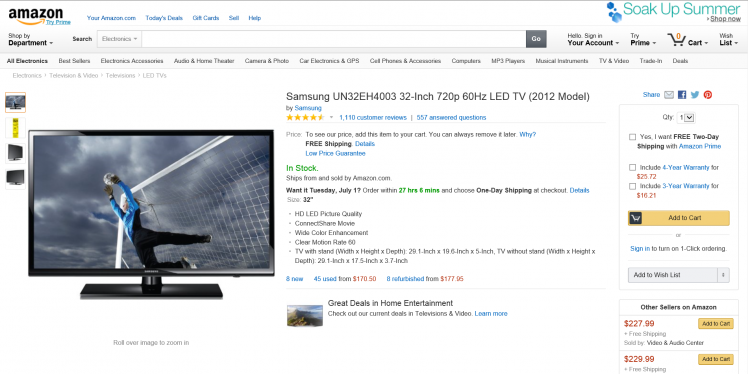
Now let us take a look how this works in practice. The Samsung UN32EH4003 television set is listed at Amazon.com without a price. Instead, it says “To see our price, add this item to your cart.” The shopper can only see the price after adding the product to the cart where it says that their price is lower than Samsung’s recommended retail price, so Samsung does not want it to be public.
If you think that the two retail giants Amazon and Samsung have adopted a successful sales model and that this approach is a good idea, I suggest googling “UN32EH4003”. You will get hits for this TV at samsung.com, amazon.com, digitaltrends.com, walmart.com, bestbuy.com, cnet.com, ebay.com, electronicexpress.com and conns.com. Each site displays a different price. Samsung doesn’t control anything; it just limits sales via online retailers who are big enough to be controlled.
Which one of these platforms will end up selling the TV? The one with the fastest and more flexible service, and with the lowest price point. This is why you will not find this TV among the bestsellers at Amazon.com.
Similarly, Google doesn’t favour the offerings of the same product at various websites with an identical photo and descriptions. For the browser, this is just a copy of one and the same site, and is therefore punished by a lower rating. If someone looks up LCD TVs, those pages will not be among the top hits, I am sure of it. Now you have another reason why it is better to be the direct retailer online.
However, even though Samsung and other similar retailers did not adapt to the new situation, smaller American business saw their chance in selling their products and services exclusively via Amazon – with great results.
Example from Slovenia, Europe: enaA.com offers you the Samsung 32H4000 with the lowest price guarantee.