Too Fast? It Will Go Even Faster


The rapid development of information technology and telecommunications over the past thirty years has been in fact a benefit of some sort. Whatever activity one was engaged in, be it in the public or private sector, an investment in some computer equipment, software applications and user training made it possible to optimize performance, reduce costs, improve quality and of course increase profit.
Naturally, some did this better than others. Slovenia and a lot of countries did not make the best of this opportunity and went down a few places on the global competitiveness scale. Nothing really dramatic. The cards on the global corporation map have shuffled even more. Apple, Google, Microsoft and Facebook became by far the largest companies in terms of market value in the world. Once the flagship, automotive industry, which is very close to and liked by the Slovenian population as well as perceived as an opportunity for economic growth, slid to somewhere below rank 20 on global list. An illustration that we are experiencing tectonic changes: US Ford and General Motors together are worth only slightly more than for instance Nike, McDonalds or Starbucks and much less than Coca Cola, Pepsi or P&G. All combined are worth less than Apple.
The company that will be the biggest in 20 years has yet to be founded. In the ABC Accelerator I have been following the growth of a new generation of successful companies practically in real time, seeing today that in a few years we will be buying differently, doing business with banks differently and communicating with the public administration differently, and we will have different relations with the electricity, water and heating suppliers … we will travel differently, select hotels differently, go to restaurants differently, undergo treatment differently, and so on. We will allocate most of the money to things we do not know yet today. The key to success is no longer growth and optimization. The companies and countries that don’t invest in novelties will fail completely, regardless of how successful they are and how much profit they make today. I am not talking about just one or a few changes. Even a country like Slovenia will need thousands.
I was surprised by the Chinese at the end of July. Theirs was the first country in the world to introduce online ride-booking regulations. The market with more than a billion users gave the green light to Uber and similar countries, making it clear they need not fear obstacles and pitfalls in winning the Chinese market. This is far from the European practice where mayors of individual towns decide about Uber, AirBnB and similar countries.
I was also surprised by Tesla. The Gigafactory producing batteries needed for its cars was set up in Nevada. At home! This is an excellent example of how innovative companies create jobs without looking for a cheaper labour force around the world. It is worth noting that in less than a year the factory will double the global battery output, only to quadruple it at a later stage, thus filling all Tesla 3 orders. Another trend that will have to be taken into account: foreign companies will no longer be able to create jobs with tax and similar benefits. A slightly different view of the entire matter reveals that investing in domestic knowledge is the only reliable path to a welfare state.
Let us have a look at how Romania boosted its high-tech industry. It reduced taxes, simplified accounting and made it easier to get credit. In a few months it succeeded in reducing unemployment, having recorded one of the lowest unemployment rates among the youth in the EU, ranking second in terms of GDP growth among the EU Member States and looks to have a good future. IT companies account for 6.1% of the country’s GDP and are expected to achieve 10% in 2017. It is important that Adobe, Microsoft, IBM, Intel and Oracle are opening their companies in Budapest because the favourable business conditions there also apply to all, both domestic entrepreneurs and global corporations, thus simplifying the opening of such companies and ensuring the conditions apply to the long-term.
And which country has witnessed the fastest growing GDP? Ireland, which has also reduced corporate income tax, attracted investors and boosted GDP to an incredible 26.3%.
The Russians will become the first to invest in Hyperloop, a new train offered by Elon Musk (Tesla, SpaceX, PayPal, …), operating at a speed of up to 1,200 km per hour. The construction will start in Siberia so as to connect Moscow and Beijing. Great Britain proved to be the most advanced when it comes to drone legislation. Amazon.com will therefore launch drone delivery there.
Who knows what will happen when the door to virtual reality opens really wide!
Original in Slovene Manager.Finance.si/8848155/Aljosa-Domijan-Tehnologija-drvi-kje-bomo-prvi-mi
How to Successfully Sell Online after Google changed

If your sales figures mainly depend on Google, Facebook, and various advertising networks, you’ve hit a dead end. Even if an average 2% of clicks end up converted to sales (not a bad result), taking into account an average price of $ 0.15 per click (also not a bad price), the cost of advertising with Google amounts to $ 7.5 per purchase. If this was the price to pay just once for a regular customer, guaranteed to buy more, you’d still be able to stay in the black. However, you will have to pay $ 7,5 for each purchase coming from Google forever. Customers are creatures of habit. The next time the majority of customers will again start their sales journey on Google. If your ad is not there this time round.
After Google changed the positions of ads and is now more advertising panel than search engine. On mobile phones whole first screen is reserved for ads. On PC’s and laptops users now see four ads first and only two to three search engine results.
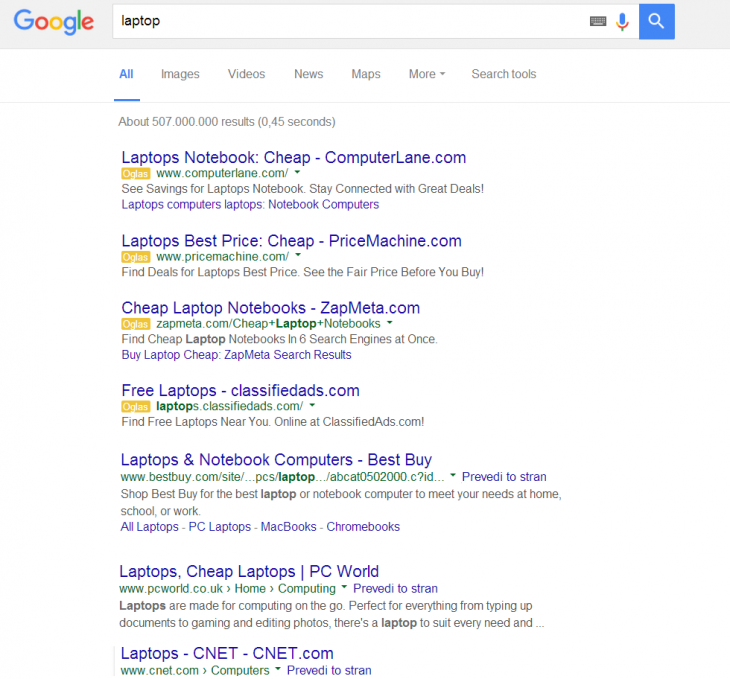
Ok. Thank’s Google. It is even more clear now how to actually successfully sell online. Just take next three steps forwards as soon as possible:
1. Calculate the actual success rate of your existing Google advertising campaigns, as well as other services where you might be paying for clicks or impressions (price comparison sites, for example are even less effective than Google), making sure the sales you generate with their help let benefits go to your pockets and not theirs. Think about whether it’s worth it in the long run!
2. Ensure your offer has the best possible content. This is a mantra repeated time and time again by all SEOs and inbound marketing experts. However, never put too much stock into how many times your keyword is written in the meta tag. What you need is a truly excellent description of your offer. It needs to be a real pleasure to read, telling buyers everything there is to know about your offer and convincing them to make a purchase. You should additionally ensure a short summary which is visible when a link to your page is published on Google, Facebook, etc. And that’s it. Believe me, if you don’t know the best description for your offer, no inbound or SEO expert can help you.
3. Instead of paying for clicks and impressions, start by only paying an adequate share of the realized sales to those who help you generate a larger number of purchases. Use performance marketing! You can find on affiliatewindow.com all top brands are using it.
Alternatively, you can post your offer in the largest online stores on the Internet:
a. Amazon.com
b. Alibaba.com
c. Ebay.com
d. enaA.com
Googlewise

Just as I was about to plant some raspberries, I turned to Google to find out when and how to do it. I love Google being able to understand questions such as When to plant raspberries? or When was George Washington born? or What is the capital of Moldova? Believe it or not, the programme for analyzing customer journeys to enaA.com also reveals very long questions. Several months ago, a customer entered the following query into Google: “Which LED TV set for less than €400 is best for kids and a living room of 5 x 4 metres?” Of course, Google knows that such TV sets are also featured on www.enaA.com, so the customer was referred to us.
But, is Google truly the tool or invention that will take the entire human race to the next level? This reminded me (without having to resort to Google to look it up) of an ancient story that was written around 400 BC. And yes, I would have to google the exact date.
Today, we tend to forget that in the beginning letters and words were not written down. Plato, through a dialogue between Socrates and Phaedrus, tells the legend of Thamus (alias Amun, Amun-Ra etc.), the ancient Egyptian king of gods, taking place at a time when people started to use writing.
At one time Thamus was host to the god Toth who was one of the most important Egyptian gods and the initiator of science and art, the inventor of numbers, mathematics, astronomy, astrology, geometry, botany, theology, medicine and writing. Toth boasted that writing would make the Egyptians wiser and give them better memories. Thamus replied: “The inventor is not always the best judge of his own inventions. Those using your invention will no longer train their memory and will become forgetful. They will put their trust in written sources when they want to retrieve information, and not to their memory. Your people will possess wisdom kept in records, and not their own wisdom. In time, there will be more and more records without any criteria or instructions. Rather than an advantage, such wisdom will become a burden. Instead of growing wiser, they will grow increasingly ignorant, instead of their memory becoming alive, they will neglect it and become forgetful.”
Let’s imagine Larry Page and Sergey Brin paying a visit to Thamus today. They would say how they had found a way to organize all the information in the world and make it available and useful to the whole world. They would conclude that from now on everyone can know everything.
Yet Thamus would reply: “Those who use your invention will no longer accumulate knowledge and will therefore know less and less. When they are curious about something, they will google it. They will boast about the knowledge that is stored on the world-wide web, and not what they themselves know to be true. In time, more and more knowledge will be at their fingertips without any criteria or instructions. Rather than an advantage, such knowledge will be a burden.”
Writing enabled mankind to evolve. So did the internet and Google, but don’t take everything that is written too literally! Let me just remind you of the copy-paste doctoral and masters theses, and the ease some people talk about things they know nothing about, apart from knowing that they are trending, not to mention politics. This is knowledge without criteria and instructions. This is boasting using someone else’s knowledge. Technology alone is therefore not enough to take us to the next level.
Ali nam Google prinaša znanje?

Ko sem sadil maline, sem vprašal Google, kdaj in kako naj to naredim. Všeč mi je, da Google razume vprašanja, kot na primer: Kdaj sadimo maline?, Kdaj se je rodil France Prešeren?, Katero je glavno mesto Moldavije? Ne boste verjeli, a v programu, ki analizira poti kupcev do enaA.com, najdemo tudi zelo dolga vprašanja. Tako smo pred meseci dobili kupca, ki je Google vprašal: »Kateri led televizor za manj kot 400 evrov je najboljši za otroke in dnevno sobo 5 x 4 metre? In Google seveda ve, da imamo take televizorje na www.enaA.com in je kupca poslal k nam.
Je Google res orodje ali izum, ki bo celotno človeštvo dvignil stopničko više? Ob tem sem se spomnil (in za to mi ni bilo potrebno pogledati v Google) na eno staro zgodbo, ki je bila zapisana tam okrog leta 400 pred našim štetjem. Ja, za točen datum bi moral pogledati v Google.
Danes niti pomislimo ne, da v začetku črke in besede niso bile pisane. A Platon je skozi pogovor Sokrata in Fajdrosa predstavil zgodbo o Tamuntu (bolj znanem tudi kot Amon, Amon-Ra, ..), staroegipčanskemu kralju bogov, ki se je odvila v času, ko smo ljudje dobili pisavo. Knjigo imamo od leta 2009 (hvala, Google!) tudi v slovenskem prevodu: Platon – Fajdros. Prevedel Gorazd Kocijančič. V: Platon, Zbrana dela, študijska izdaja, II. knjiga, str. 529–574. Ljubljana: KUD Logos, 2009
Nekoč je Tamont gostil boga Tota, enega izmed najpomembnejših staroegipčanskih bogov, začetnika znanosti in umetnosti, izumitelja števil, matematike, astronomije, astrologije, geometrije, botanike, teologije, medicine in pisave. Tot se je pohvalil, da bo pisava Egipčanom dala še več modrosti in boljši spomin. Tamunt pa mu je odgovoril: » Izumitelj običajno ni najboljši sodnik svojim iznajdbam. Tisti, ki bodo uporabljali tvoj izum, ne bodo več urili svojega spomina in bodo postali pozabljivi. Ko se bodo želeli nečesa spomniti, bodo iskali med zapiski in ne več v svojem spominu. Tvoji ljudje se bodo ponašali z modrostjo, ki bo hranjena v zapisih, ne s svojo modrostjo. S časom bodo imeli na voljo vse več zapisov brez kakršnihkoli meril in navodil. Ta modrost jim bo bolj v breme kot korist. Namesto, da bi bili modrejši bodo vse bolj nevedni, namesto, da bi bil njihov spomin vse bolj živ, ga bodo zanemarjali in postali pozabljivejši.«
Predstavljajmo si, da danes Tamunta obiščeta Larry Page in Sergey Brin. Povedala bi mu, da sta iznašla način, kako organizirati vse informacije na svetu ter omogočiti njihovo dostopnost in uporabnost za vse. Odslej lahko vsak ve vse, bi zaključila.
Tamunt pa bi odgovoril: »Tisti, ki bodo uporabljali vajin izum, ne bodo več nabirali znanj in bodo vedeli vse manj. Ko bodo želeli nekaj vedeti, bodo to pogooglali. Ponašali se bodo z znanjem, ki bo shranjeno na svetovnem spletu, ne s tem, kar vedo sami. S časom bodo imeli na voljo vse več znanja brez kakršnihkoli meril in navodil. To znanje jim bo bolj v breme kot korist.«
Pisava je človeštvu omogočila razvoj. Tudi svetovni splet in Google ga, da ne bo kdo vzel vsega napisanega preveč dobesedno. A naj vas spomnim na skopirane doktorate, magisterije, na to, s kakšno lahkoto govorijo o stvareh, o katerih ne vedo ničesar drugega, kot da je trend, politiki. To je znanje brez meril in navodil. To je ponašanje s tujim znanjem. Zato, da bomo naredili korak naprej, ni dovolj tehnologija.
Naslovna slika Charlotte Davies – Osmoza